
Do you like the content I create? Consider buying me a coffee or purchasing one of my DMs Guild supplements. Every cent puts me one step closer to making TTRPGs my full-time job.
Every once and awhile, I receive a notification from an aspiring game designer asking for advice. The tabletop community is brimming with avid game masters, players, and worldbuilders eager to share their creations. With a few DMs Guild best sellers to my name, folks often ask me about publishing on the DMs Guild.
These questions are always humbling—after all, I still consider myself an aspiring game designer at heart! Not long ago, I was firing off applications to Wizards of the Coast for any job I could get. “Maybe if I can nab a janitor position,” I thought, “I could tack an adventure on a bulletin board near Chris Perkins’ office, a la the chalkboard scene in Good Will Hunting.” I could have benefited from some entry-level advice for sure.
Over the past few years, the DMs Guild has blossomed from a budding platform into an active community, home to some of the best third party content that D&D 5th Edition has to offer. Currently, the DMs Guild is the only platform where you can directly benefit from the sale of original content featuring official D&D properties such as the Forgotten Realms, Strahd Von Zarovich, or Acererak’s mad shredding skillz. On top of that, the DMs Guild Adepts program includes some of the best and brightest D&D creators in the industry, and brand manager Lysa Penrose has put in countless hours working to make the Guild a more inclusive, positive, and welcoming space.
Throughout my time on the Guild (that’s what the cool kids call it), I’ve learned many valuable TTRPG lessons. Some of them came easily, taught to me by friends, mentors, and generous peers, while others were the products of hard work or failure. I’m a big proponent of paying things forward, so I’ve created this article as a sort of landing page for new creators.
Resources
Before I begin, I wanted to list a few helpful resources.
Getting Started on the DMs Guild. This article by James Introcaso helped me when I first dipped my toes into the waters of the Guild, and I’m sure it will help you. James is the creator of Roll20’s Burn Bryte, Managing Editor at MCDM, and credited on several official D&D hardcovers. “Getting Started on the DMs Guild” breaks down the major beats of the creative process, from concept to a published product. Be sure to read James’ article if you need an overview of the TTRPG writing process.
Getting Started on the DMs Guild. Yes, this article has the same name as the one above! But this one is a more support-driven article written by the folks at DMs Guild and OBS. Think of it as a checklist to review at least once before you begin your project. Review it again before you go to publish—the last thing you want is your product taken down on release day because you forgot the DMs Guild Logo!
D&D House Style Guides. These free resources, written by members of the Dungeons & Dragons creative team, are designed to help you write content that’s in-line with official D&D standards. Though there are some slight formatting variations between official publications, these resources are absolutely essential if you want to emulate D&D 5th Edition style in your work. I highly recommend you familiarize yourself with these resources. While it’s okay to deviate from them, DMs Guild customers expect some degree of consistency. If your work is drastically different from what they’ve come to expect in 5th Edition, your audience may struggle to incorporate it in their games.
RPG Writer Workshop. This digital academy was created by Ashley Warren, a TTRPG titan whose credits include Hekna!, Icewind Dale: Rime of the Frostmaiden and the critically acclaimed Uncaged Anthology series. In addition to the very popular Write Your First Adventure course, the RPG Writer Workshop has a poppin’ Discord channel where you can connect and learn with other creators.
Becoming a D&D Designer. I was on this panel with D&D heroes Celeste Conowich, Lysa Penrose, and Ashley Warren for D&D Celebration 2020. I can testify that I would have personally benefited from this panel early on! You’ll see some of its information echoed in the article below.
First, Write the Thing
So, you’ve got an idea, and you want to publish it on the DMs Guild. That’s great! Your creations deserve to see the light of day. The first step is to write the thing.
This article isn’t about writing—I’m assuming you can handle that part! What makes writing “good” is subjective, but my writing has improved from following insightful creators like Teos Abadia, M.T. Black, James Haeck, Sly Flourish, Hannah Rose, and Shawn Merwin. I’ve also learned a lot by working with my partner in crime, Anthony Joyce, on several projects. Ultimately, your writing style is impacted by the subject matter of your supplement, your personal preferences, and the audience for which you’re writing.
General DMs Guild Writing Tips
Okay, so I lied. I can’t just throw you into the deep end like that! Here are a few quick tips for writing your first DMs Guild Supplement.
- A Bigger Audience. Writing for the DMs Guild is not the same as writing for your home game. Cast a wide net that gives Dungeon Masters and players the tools to approach a scenario in a variety of ways. Don’t tell stories. Give tools.
- Collaborate. Unless your project is small, I highly recommend working with at least one other writer. The experience will make both of you better creators. You’ll think of things that other collaborators don’t and vice versa, and the idea generation phase—which might just be my favorite part—is a lot better when you can pitch your ideas with someone else before they hit the page.
- Hire an Editor. You think finding a typo in your Tweet is bad? How about discovering twenty of them a week after you’ve released!
The Three Pillars of DMs Guild Supplements
Just like a D&D session, you can break down any given DMs Guild project into three categories.
- Writing & Editing
- Artwork
- Graphic Design
Let’s talk about editing first.
Editing
Remember when I said hire an editor? I wasn’t joking. Editors are like blacksmiths, removing impurities from your writing and giving your words the cutting edge that lets the pen rival the sword. Even if you’re just writing for fun, I strongly recommend that you hire an editor. They are well worth the investment.
There are three types of editing:
- Proofreading. The most basic form of editing. A proofreader reviews a document and identifies mistakes such as spelling, grammar, punctuation, and formatting.
- Copyediting. A copyeditor analyzes a document in terms of grammar, spelling, flow, and syntax. In addition to correcting errors and inconsistencies, a copyeditor may recommend slight changes to improve a sentence or paragraph. On the DMs Guild, this may also involve them reviewing your work for adherence to the D&D House Style Guide.
- Developmental Editing. A developmental editor reviews your project as a whole. They look at the big picture, examining your work in terms of structure, style, content, pacing, and/or value. Think of a developmental editor as a sculptor, reshaping your work to be more in line with your vision.
The Cost of Editing
Prices vary between editors, but services are generally priced based on the degree of involvement. Proofreading is relatively inexpensive (I’ve seen anywhere from 1-3 cents per word for the DMs Guild) when compared to copyediting (3-6 cents per word), while developmental editing can rival rates for consulting or sensitivity reading (10 cents or higher). The longer your project is, the more you need to budget for editing. As a brief disclaimer, industry-standard rates are often higher than on the DMs Guild.
Artwork
You’re probably going to need some artwork, even if it’s just for the cover page! Tables, bullets, and other design elements can help break up a wall of text, but including a striking piece of artwork every few pages keeps readers from getting fatigued.
You don’t have to commission a single piece of artwork for your DMs Guild supplements. If you’re willing to do some legwork, you can source art without breaking the bank or underpaying artists. Here are some tips for cutting the costs on art assets:
- D&D Creator Resources. Unless you’re a DMs Guild Adept, you can’t replicate official art in your products. However, the DMs Guild does contain a few collections of artwork in their DMs Guild Creator Resources, which you can find on the Logo and Artwork Questions page. You should also just give this page a review in general. It’s all good stuff. There are some great pieces in the Creator Resources, but you’re going to have to do a little hunting; last I checked, the pieces didn’t have any established naming convention.
- Stock Art. There are several artists on the DriveThruRPG who publish stock art at a highly discounted rate compared to industry standard. Here’s a link to the stock art page. The trade-off is that other creators can also access this license, and other products are likely to have the same piece you bought within their pages or maybe even on the cover. Don’t let that dissuade you, though. Industry-standard covers can run you anywhere from $300-1,000 depending on the individual artist and their rates.
- Game Assets. Some companies market to app developers, bundling assets aimed at fantasy-themed smartphone games. Preparing to write some magic items? Look at game asset websites like Rexxard. They make tons of assets for books, monsters, spells, and potions that you can drop into your project for just a few bucks. And of course, whenever possible, you can always write your content around the artwork you have.
- Licensing Art. I’ve seen a few very successful products on the DMs Guild utilize licensed art. An artist may work on a piece for practice, pleasure, or another project with non-exclusive rights to their work. If it fits, you can always reach out to the artist—politely and professionally—and inquire whether any pieces are available for a one-time license for your supplement. Pick a few candidates from their portfolio and have them ready when you reach out. Some artists’ rates may depend on the piece you’re licensing, or they might offer bundle pricing if you license multiple pieces.
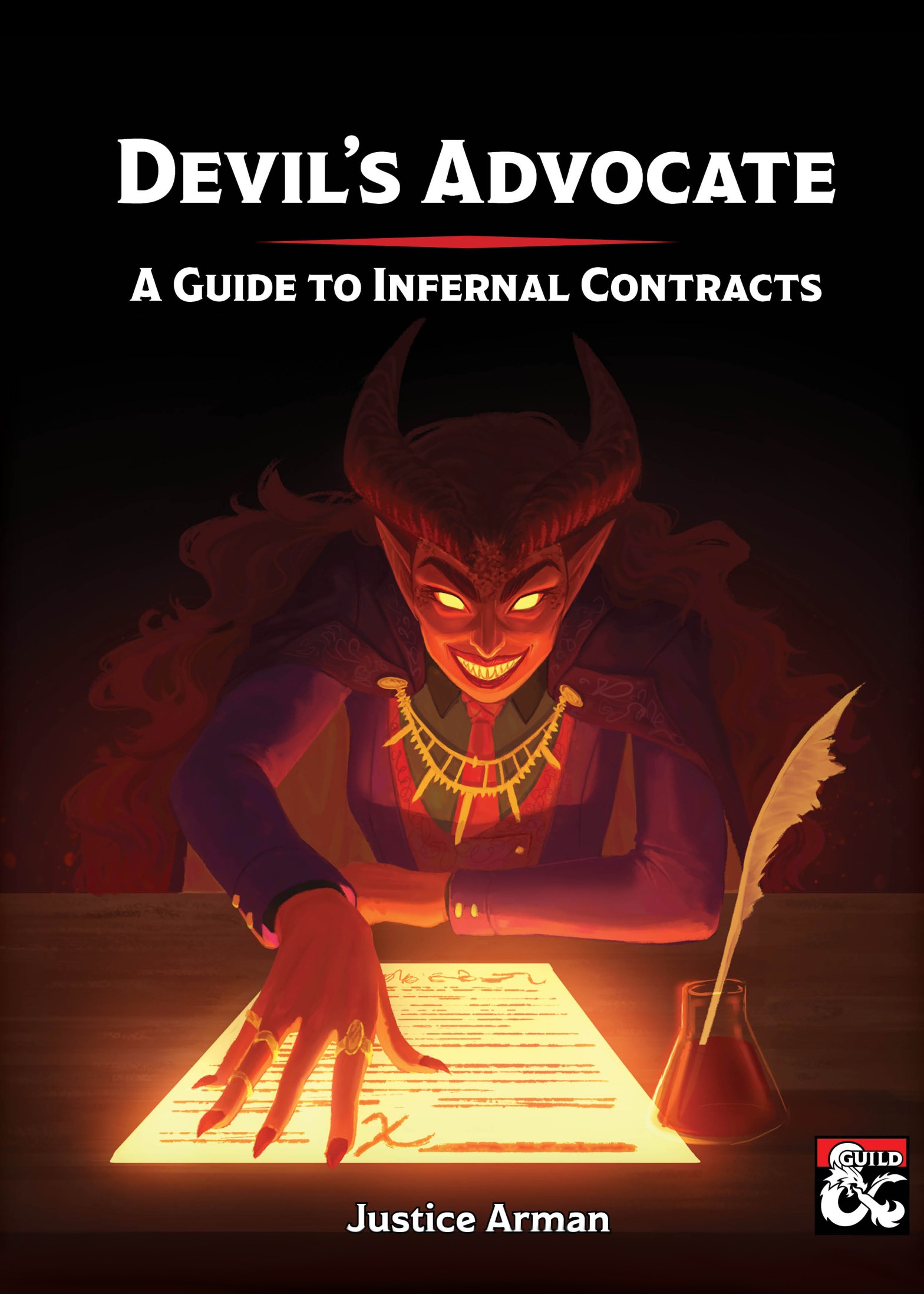
If you do decide to commission artwork for your products, my recommendation is to start with the cover and go from there. Especially around official D&D releases, the DMs Guild is flooded with new content, and a stand-out cover can help set your product apart from the rest. You don’t have to commission a full-page cover, either. A half-page cover with good graphic design, like I had for the Mithral-best-selling Devil’s Advocate: A Guide to Infernal Contracts, works just as well!
Layout
Once you’ve got everything ready to go—your work has been written, playtested, and edited, and your artwork has been chosen—it’s time to go to layout. Finding a good layout artist who’s available can be a challenge, so be on the lookout for designers early on.
Layout artists vary in pricing, depending on their experience, rates, and the complexity of your project. A layout artist may charge anywhere from $5-10 a page or more for DMs Guild work, possibly including a flat project fee. Some prefer to work for a royalty share, asking for 5-10% of a project’s sales revenues. Again, industry-standard rates for layout and/or graphic design may exceed those listed in this article.
Can’t find or afford a layout artist/graphic designer? Here are a few ways you can do it yourself.
- GM Binder and NaturalCrit’s Homebrewery let you format your products based on a simple, predetermined style. There’s a bit of a learning curve, but once you understand each interface’s capabilities and associated dialogue, it’s smooth sailing. My very first title, Heart Hunt, used one of these programs.
- What if I told you that you could lay your entire product out in Microsoft Word? Well, you can! It’s a bit of a pain, but you can plug in page assets and artwork, export them to PDFs, and even include familiar page textures as image backgrounds. You might not know it, but there are several best-selling DMs Guild projects whose layouts were done in Microsoft Word.
A good friend of mine and talented editor, Laura Hirsbrunner, created a Simple 5E Template for Microsoft Word to make such layouts a breeze. Yes, there are instructions.
The Final Stretch
Your project is finally complete. You wrote the thing, then an editor revised your words. You sourced artwork, and gave that to a layout artist. Congratulations! You’ve earned a short rest. After that, it’s time to finish strong.
Pricing Your Product
A lot of creators struggle when it comes to pricing their work. Please don’t work for free. The more free and underpriced products there are on the market, the less creators get paid. Worse, consumers start to expect them as the norm, passing up on otherwise spectacular products in favor of underpriced alternatives. Help us legitimize the tabletop industry by promoting fair pay.
Price Per Page
Joe Raso recently put together a price breakdown of the Top 100 products on the DMs Guild for 2020, comparing his results to a similar analysis from the previous year. Looking at Joe’s data, products with 100 pages or less sit around 15-20 cents per page in terms of price, increasing above that when you have less than 30 pages. Based on this, you could price your 50-page supplement anywhere between $7.50-10 or more. If your supplement small—I’m talking 10 pages or less—the data is less reliable, but I’d recommend charging anywhere between $1-5.
The past year has taught us that the DMs Guild can sustain higher prices without having to justify them with hundreds of pages of content. With new TTRPG books dropping every day, there’s a growing market for compact, high-quality supplements. Take Heavyarms’ Armorer’s Handbook, for example, a fantastic Adamantine-best-selling product. It has a price point of $9.95, but just 28 pages of content! If you’ve read the supplement, however, you know that it’s worth every penny.
Benchmark Pricing
You can also price your supplement based on similar products on the market. When looking for a benchmark product, consider your supplement in terms of production value, genre, type (such as adventures, magic item supplements, variant rules, etc.), page count, and audience size. Try to refine your search to supplements released in the last year.
Budget-Based Pricing
You can also price your project based on your budget. Assuming you’re the only contributor receiving royalties, you’ll get 50% of every sale. How many sales are you predicting? What price point do you need to offer to break even? For example, if you spent $50 on your supplement, and you price it at $5, you’ll need 20 sales to break even. After that, it’s all profit!
Publishing to the DMs Guild
The Resources links above include instructions on preparing your title for publishing. At minimum, make sure your project checks the following boxes:
- You either own, licensed, or have obtained permission to use all of the content in your title, and you’ve credited creators wherever appropriate for any work contained therein. This includes both artwork and writing.
- You’ve stuck the DMs Guild logo from the Logo and Artwork Content page on your cover and in the thumbnail, and no other branding logos are on your cover.
- Your content uses the D&D 5th Edition ruleset.
- You’re using approved settings (if applicable, setting neutral is okay), such as the Forgotten Realms, Eberron, Ravenloft, or Ravnica. Reminder: You cannot publish your own settings on the DMs Guild. Check out the DriveThruRPG for that.
- You’ve included the legal text found here on your credits page: Ownership and License (OGL) Questions page
- You have read and understand the DMs Guild Community Content Agreement.
If you’ve got all that, publish that thang! Then, it’s time to tell the world about your title.
Marketing & Advertising
Once you’ve got a finished product in your hands—or at least something to generate hype prior to release day—it’s time to advertise it. This is arguably one of the most important yet ambiguous aspects of any TTRPG project. Every day, beautiful products go unnoticed simply because customers don’t know they exist.
Here are a few tips for marketing and advertising your supplement.
- Write Out Your Unique Selling Proposition. Ew, you got business in my TTRPGs! Don’t worry. A unique selling proposition (USP) is a just fancy marketing term that answers the question, “What makes your product special, and why should your customers care about it?” Understanding this will help you when posting about your product.
- Create An Attractive Product Page. Tell potential customers what they’re getting in your supplement. Keep it focused and concise.
- Know Your Audience. Twitter, Facebook, and Reddit all have different kinds of D&D audiences. The more your post matches the “vibe” associated with each platform, the more likely it is to gain traction.
- Keep Promoting. Your product will continue to gain sales after any release day buzz has died down, albeit at a slower pace.
- Pay It Forward. No one wants to follow an ad account. Early on, someone told me that for every self promotion post, there should be 2-5 where you’re offering original content, insights, or engaging with other creators. TTRPGs are a team sport! Celebrate other creators—you might just work with them one day!
Manage Your Expectations
My last recommendation is to manage your expectations. Most products on the DMs Guild don’t sell more than a handful of copies in their first week, let alone the first couple of months. Unless you have an established audience elsewhere, your first project will probably fall in line with that trend. Rest assured, you’re not alone.
Everyone has an underperforming project eventually, and it stings every time. What matters is that you keep creating.
My first two projects, Heart Hunt and Oath of the Aesir, didn’t sell very many copies. It wasn’t until my third project, Devil’s Advocate, that I really felt like I found my stride. Even if you have a stand-out project, there’s no guarantee that you’ll maintain that trend—in fact, you almost certainly won’t. Three months after releasing Devil’s Advocate, I put out my milk-themed carnival horror adventure, Step Right Up. Guess what? It still hasn’t broken even!
There’s a saying in the DMs Guild community that most supplements have a “long tail.” Regardless of where your product peaks when you release it, you’ll still sell a copy or two every so often. It might not seem like much at first—a sale every week or two, maybe a couple in one week and none in others. But over time, you’ll notice that those sales add up. As you keep creating, that single sale in your first week suddenly becomes sixty sales in your first year, and you’re the proud new recipient of a copper bestseller metal.
We all fail sometimes, but with each setback comes new knowledge and opportunity. Failure hasn’t stopped me from creating—it won’t stop you, either.
Like this article? Consider supporting me by buying one of my products on the DMs Guild, such as Darkhold: Secrets of the Zhentarim or Elminster’s Candlekeep Companion. If you’re running Baldur’s Gate: Descent into Avernus, consider picking up an alternative introductory adventure to the campaign, Devil’s Advocate: A Guide to Infernal Contracts, or Baldur’s Gate: City Encounters.
You can also follow me on Twitter at @justicearman or sign up for my email list, the Gjallarhorn, for exclusive updates, playtest opportunities, and discounts.




 Justice Ramin Arman